
Large-Scale E-Governance Transformation for a Southeast Asian Public Service Agency
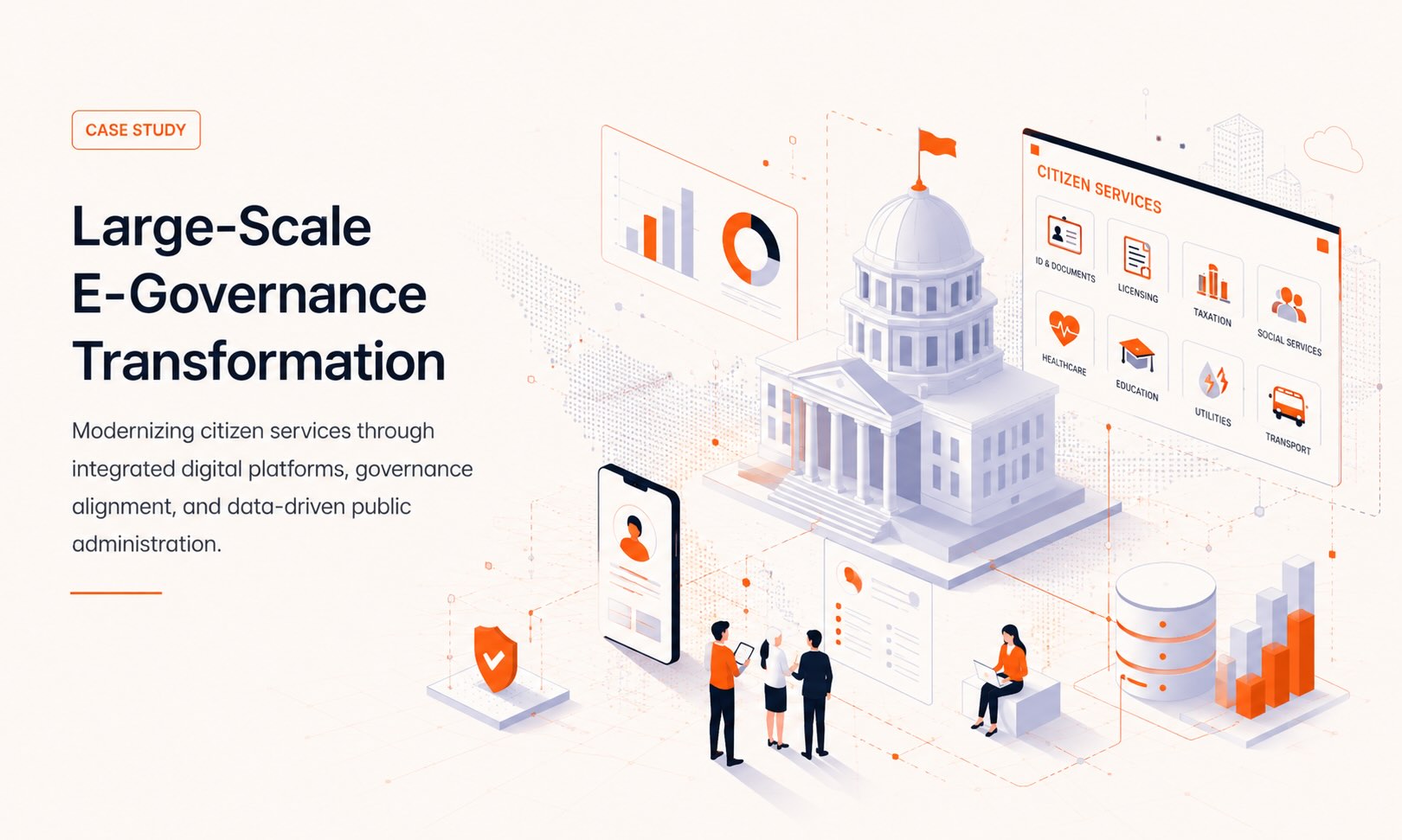
Modernizing citizen services through integrated digital platforms, governance alignment, service redesign, and data-driven public administration.
This case study reflects the experience and expertise of members of The Thinkers Lab leadership team gained through large-scale transformation initiatives across public sector and enterprise environments. Specific client details have been generalized to respect confidentiality obligations.
This representative case study reflects experience gained through large-scale transformation programs, supporting a government organization responsible for delivering services to millions of citizens across multiple departments and service channels.
The transformation objective was to move from fragmented service delivery toward a citizen-centric digital ecosystem capable of supporting scalable, transparent, and efficient public services.
The initiative focused on improving accessibility, operational efficiency, service integration, governance effectiveness, and digital readiness.
CHALLENGES
Before the modernization initiative, the organization faced systemic challenges commonly experienced by large governments:
-
Multiple departmental silos
-
Fragmented citizen service journeys
-
Disconnected applications and databases
-
Legacy systems and infrastructure
-
Limited data visibility
-
Manual approval workflows
-
Inconsistent service delivery experiences
-
Growing citizen expectations for digital-first services
-
Challenges coordinating across agencies
APPROACH
The program involved deploying a strategic transformation framework tailored for public sector scale and complexity, which included:
-
Current state assessment
-
Stakeholder engagement across departments
-
Citizen journey mapping
-
Digital service architecture design
-
Governance and operating model review
-
Platform consolidation strategy
-
Data integration roadmap
-
Change management planning
-
Digital capability development
SOLUTION
The modernization program implemented the following core capabilities:
-
Unified citizen service platform
-
Digital service workflows
-
Life-event-based service delivery framework
-
Shared digital infrastructure
-
Cross-department integration layer
-
Centralized service monitoring
-
Digital identity integration
-
Data-driven decision support
-
Governance and compliance controls
-
Scalable architecture supporting future AI adoption
OUTCOMES
The transformation program delivered significant, measurable public value:
-
Improved citizen access to government services
-
Reduced service delivery complexity
-
Increased operational efficiency
-
Better inter-department collaboration
-
Improved transparency and accountability
-
Enhanced decision-making capabilities
-
Stronger digital governance foundations
-
Increased readiness for AI-enabled public services
LESSONS LEARNED
-
Citizen-centric design must drive service transformation.
-
Technology modernization alone does not create transformation.
-
Governance and operating models are equally important.
-
Shared digital platforms accelerate service innovation.
-
Data interoperability is critical for modern government.
-
Long-term transformation requires institutional alignment and leadership commitment.
WHY THIS MATTERS
Governments globally are moving beyond simple digitization toward fundamental operating model transformation. Key focus areas include:
-
Integrated digital service delivery
-
Life-event-based citizen services
-
AI-enabled governance
-
Digital public infrastructure
-
Data-driven public administration
Positioning these capabilities at the core of modernization initiatives is foundational for building future-ready governments that can adapt to changing demographic needs and technological advancements.
EXPERIENCE NOTE
The transformation experiences described in this case study reflect expertise gained by members of The Thinkers Lab leadership team through prior engagements and large-scale transformation programs. Client identities, organizational details, and implementation specifics have been generalized for confidentiality.


The future of public service delivery depends on the successful integration of strategy, governance, technology, and execution. We help governments and institutions design transformation programs that create lasting value for citizens and stakeholders.